


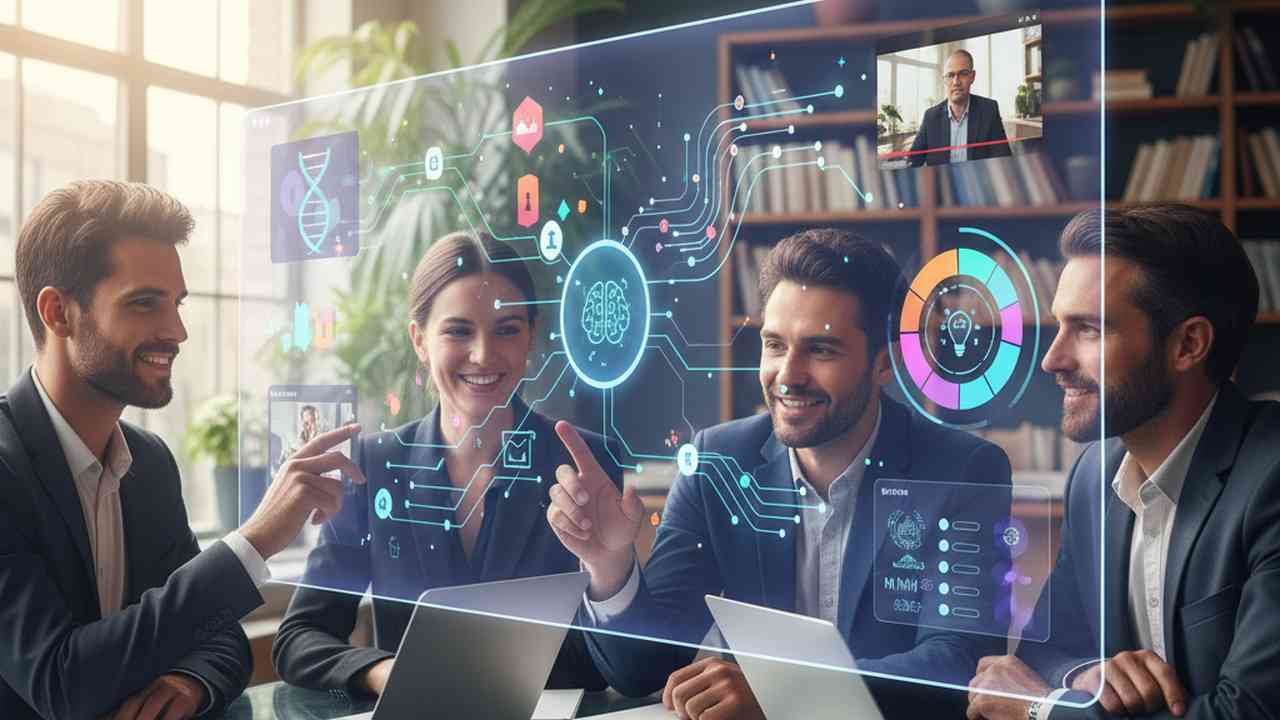
In the ever-evolving landscape of education, online learning platforms have emerged as powerful catalysts for transforming traditional learning paradigms. These platforms, equipped with cutting-edge multimedia and interactive content, are not just altering how we learn – they’re revolutionizing our capacity to retain knowledge. Imagine immersing yourself in a learning experience where every lesson is a vivid tapestry of sights, sounds, and interactivity, designed to captivate your senses and cement information in your memory. This isn’t a distant dream; it’s the reality of modern online education. And if you’re not part of this transformation, you’re missing out on a monumental shift in how knowledge is absorbed and retained.
At the heart of this revolution lies the integration of multimedia elements – videos, animations, infographics, and interactive simulations – that cater to diverse learning styles. These elements do more than just present information; they engage learners in a multisensory experience that enhances comprehension and retention. For instance, a complex scientific concept becomes more accessible when accompanied by an animated video that visually demonstrates the process, allowing learners to grasp abstract ideas through visual representation.
Moreover, interactive content such as quizzes, drag-and-drop activities, and scenario-based simulations compel learners to actively participate in their learning journey. This active engagement fosters deeper understanding and long-term retention, as learners are not passive recipients of information but active constructors of knowledge. The immediacy of feedback in these interactive modules further reinforces learning, allowing students to identify and correct misunderstandings in real-time.
But the benefits extend beyond mere engagement. Research has consistently shown that interactive and multimedia-rich learning experiences significantly outperform traditional lecture-based instruction in terms of knowledge retention. A study published by the Digital Learning Institute highlights that learners exposed to multimedia content demonstrate improved recall and application of information compared to those who engage with text-based materials alone. This is particularly crucial in today’s fast-paced world, where the ability to swiftly acquire and apply knowledge is paramount.
Furthermore, the flexibility of online learning platforms allows learners to revisit content at their own pace, reinforcing learning through repetition and spaced intervals – a technique proven to enhance memory consolidation. Whether it’s re-watching a tutorial, retaking a quiz, or exploring additional resources, the autonomy provided by these platforms empowers learners to take control of their educational journey.
Incorporating principles of existentialist education, which emphasizes individual agency and authentic learning experiences, these platforms align with the philosophy that education should be a personal and transformative journey. By offering personalized learning paths, adaptive assessments, and opportunities for self-directed exploration, online learning platforms embody the essence of existentialist education, empowering learners to take ownership of their learning and pursue knowledge that resonates with their personal interests and goals.
However, the question arises: Why are some learners still hesitant to fully embrace these innovative platforms? The answer often lies in a lack of awareness or understanding of the transformative potential these tools offer. Many are accustomed to traditional educational methods and may be skeptical about the efficacy of online learning. It’s crucial to recognize that the landscape of education is rapidly changing, and those who fail to adapt risk falling behind.
To fully capitalize on the advantages of online learning platforms, it’s essential to not only utilize the tools available but to engage with them actively and purposefully. This means approaching learning with curiosity, embracing the interactive features offered, and seeking out opportunities to apply knowledge in real-world contexts. By doing so, learners can ensure that they are not merely consuming information but are actively constructing and internalizing knowledge that will serve them in the long term.
In conclusion, online learning platforms equipped with multimedia and interactive content are not just enhancing knowledge retention – they’re redefining the learning experience. By engaging multiple senses, fostering active participation, and aligning with the principles of existentialist education, these platforms offer a dynamic and personalized approach to learning. The future of education is here, and it’s interactive, immersive, and tailored to the individual. Don’t miss out on the opportunity to be part of this educational revolution – embrace the change and unlock your full learning potential today.
