


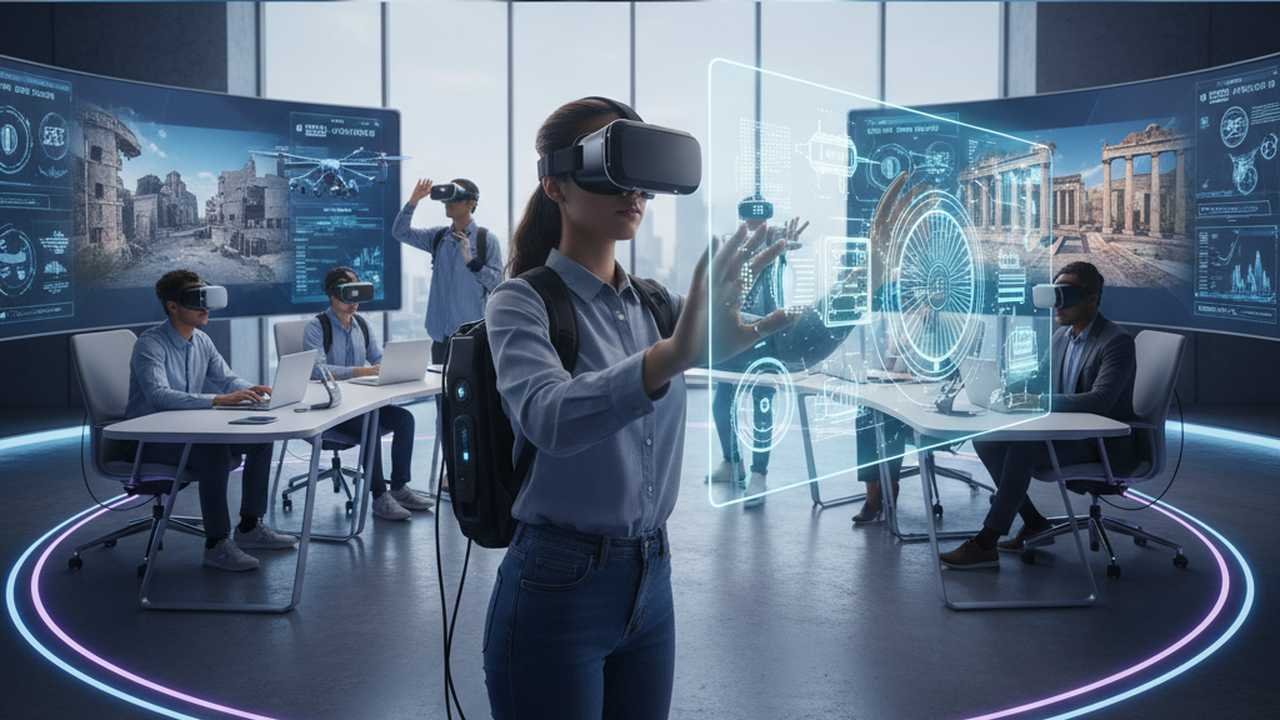
The New Era of Learning: How Virtual Reality Is Redefining Education
In a world where information evolves faster than textbooks can be printed, Virtual Reality (VR) has emerged as the groundbreaking solution to immersive, practical learning. This technology is no longer the distant dream of futuristic labs – it’s here, it’s tangible, and it’s reshaping classrooms, laboratories, and training centers worldwide. For every educational technology specialist striving to stay ahead of the curve, VR represents a revolution you simply cannot afford to ignore. Imagine a world where students walk through the streets of ancient Rome, dissect complex molecules in three-dimensional space, or explore the solar system in breathtaking, panoramic realism. These are not abstract concepts – they’re experiences happening right now in schools and institutions that have chosen to embrace VR early. The urgency to adopt this technology is undeniable. Those who delay risk being left behind in an educational landscape that rewards innovation, adaptability, and interactivity. The fusion of sensory engagement and hands-on virtual simulation is transforming learning into something visceral, visual, and vibrantly alive.
Immersive Learning: The Power of Presence and Engagement
One of the most profound advantages of Virtual Reality in education is its ability to create a genuine sense of presence. When learners don a VR headset, they’re no longer passive recipients of information – they’re participants in a vivid, living environment that commands attention and emotion. A seasoned educational technology specialist knows that engagement is the currency of modern learning, and VR delivers it in abundance. The immersive nature of VR captivates the mind, reduces distractions, and strengthens retention through experiential interaction. Imagine a medical student practicing surgery in a lifelike operating room, complete with the hum of monitors and the sterile gleam of instruments, or an engineering trainee manipulating virtual prototypes in real time, without the cost or risk of physical materials. Every sense is activated, every neuron is firing, and every moment becomes an opportunity for deep learning. The psychological impact of immersion is undeniable; studies show that students in VR environments recall information up to 30% more effectively than those in traditional classrooms. The message is clear – immersion equals impact, and those who fail to adopt it risk irrelevance in tomorrow’s educational ecosystem.
From Theory to Practice: Bridging Knowledge with Real-World Application
VR demolishes the walls between theoretical understanding and practical execution. Traditional methods often struggle to simulate real-world complexity, but with VR, learners can apply abstract concepts instantly in safe, simulated environments. Picture a geography lesson where students navigate tectonic plates and witness volcanic eruptions up close, or a chemistry class where reactions unfold in dazzling three-dimensional sequences. These are not fantasies – they are tools available today, used by forward-thinking institutions that partner with cutting-edge developers and certified educational technology specialists. The results are staggering: faster learning curves, fewer safety concerns, and dramatically improved student confidence. Corporations are leveraging VR to train pilots, surgeons, and mechanics under controlled conditions that mimic real life with uncanny precision. Universities are deploying VR labs to let students test, fail, and try again without fear of damage or loss. This shift toward hands-on, immersive application transforms education into an active journey rather than a passive lecture. The call to action is urgent – those who hesitate will find themselves trailing in a world where knowledge must translate into skill, instantly and effectively.
Emotional Learning: Connecting Hearts and Minds Through Virtual Reality
Education is not just about intellect – it’s about emotion. The most impactful learning experiences are those that touch us deeply, and VR has an unmatched capacity to evoke emotion through immersive storytelling and sensory design. An educational technology specialist can harness this emotional connection to amplify empathy, motivation, and understanding. Imagine students standing in the middle of a refugee camp, feeling the tension and humanity of crisis situations as part of a global studies course, or walking through art galleries where they can almost smell the oil paint and sense the brushstrokes of masterpieces. These experiences leave lasting impressions that lectures or textbooks cannot replicate. When learners emotionally connect with content, they remember it, internalize it, and act upon it. Emotional learning through VR is not just effective – it’s transformative. Educators who integrate this technology are not merely teaching; they’re shaping perspectives, nurturing empathy, and building global awareness. In a rapidly changing world, those who create emotionally resonant learning experiences will shape the leaders of tomorrow. The future belongs to educators who dare to immerse, inspire, and ignite emotion through virtual reality.
Data-Driven Insights: Measuring Impact and Maximizing Results
Behind every breakthrough in virtual learning lies powerful data. VR platforms offer advanced analytics that track eye movement, engagement duration, and interaction quality in real time. This treasure trove of information empowers the educational technology specialist to refine learning strategies, personalize content, and maximize outcomes. Instructors can see which modules hold attention longest, which tasks cause difficulty, and where learners excel. These insights fuel continuous improvement, ensuring that each learning experience becomes more effective than the last. The integration of artificial intelligence and VR analytics allows predictive modeling – identifying potential skill gaps before they hinder progress. Verified reports from institutions like Stanford and MIT show that VR-integrated programs can accelerate learning efficiency by up to 400%. Data does not lie, and the numbers paint a clear picture: the institutions that embrace VR analytics are outperforming those that rely solely on static, outdated systems. The urgency is palpable – data-driven VR education is not a luxury; it’s a necessity for anyone serious about achieving measurable, scalable learning success in the digital age.
Licensing, Security, and Verified Content Integrity
One of the primary concerns for any institution adopting emerging technologies is security and content authenticity. A responsible educational technology specialist ensures that all VR learning modules comply with verified licensing agreements, certified data protection protocols, and intellectual property laws. Leading VR content providers offer fully licensed materials that are curated and verified by trusted academic institutions. This not only safeguards learners but also enhances credibility and compliance with international standards. Encryption protocols and secure cloud storage ensure that student data remains confidential, adhering to GDPR and FERPA regulations. Verified payouts for VR developers and transparent licensing agreements eliminate the risk of counterfeit or unauthorized materials. These layers of trust create a secure, ethical ecosystem where innovation thrives without compromise. The message is clear: adopting VR responsibly is not just about embracing technology – it’s about preserving integrity, protecting learners, and establishing lasting trust. Those who align with verified, secure, and licensed VR platforms will not only elevate their institution’s reputation but also future-proof their programs against legal and ethical pitfalls.
Real-World Success Stories: Institutions That Transformed Learning with VR
Across the globe, schools, universities, and corporations are proving that VR is not just an enhancement – it’s a game-changer. The University of Glasgow introduced a VR-based anatomy lab that increased retention rates by 47%. Boeing uses immersive VR simulations to train mechanics on jet assembly, cutting error rates by over 30%. Nursing programs in California now include VR patient simulations that replicate real-time emergencies with startling accuracy. These are not isolated victories – they’re signals of a massive shift. Behind each success story stands an educational technology specialist who understood the power of timing and innovation. Those who embraced VR early are reaping the rewards: enhanced reputation, increased student satisfaction, and stronger industry partnerships. The window of opportunity, however, is closing fast. Every month, more institutions adopt VR, raising the bar for immersive standards. The question for every educator and administrator is urgent – will you be among the pioneers who lead this transformation, or one of the many trying to catch up once the revolution has already passed?
Overcoming Barriers: Accessibility, Cost, and Implementation Strategies
While the promise of VR is electrifying, implementation can feel daunting. Hardware costs, content development, and integration logistics often pose challenges. But today’s landscape offers unprecedented accessibility. Affordable standalone VR headsets have eliminated the need for high-end PCs, and subscription-based VR learning platforms allow schools to pay only for what they use. Forward-thinking educational technology specialists are now designing scalable VR strategies – starting small, proving results, and expanding rapidly. Partnerships with content developers, grants from educational technology funds, and government incentives have made adoption more feasible than ever. The once-prohibitive costs are dropping fast, and the real cost now lies in hesitation. Every semester without VR is a missed opportunity to captivate, motivate, and transform learners. The time for excuses has ended; the time for action is now. Those who move quickly will establish themselves as leaders in the next generation of experiential education, while those who delay will find themselves fighting to remain relevant in a world that no longer tolerates passive learning.
The Future Is Now: Seize the VR Learning Revolution
We are standing at the edge of an educational renaissance, driven by virtual reality and powered by the creativity of the educational technology specialist. The tools are here, the data is clear, and the potential is limitless. VR learning is not just about novelty – it’s about necessity. In a hyperconnected world where attention spans are shrinking and competition for engagement is fierce, immersive learning offers an irreplaceable edge. The FOMO is real: every institution that waits risks falling behind competitors already using VR to attract students, improve outcomes, and build prestige. This is the moment to act, to invest, and to lead. Partner with verified VR platforms, train your staff, and transform your curriculum into a living, breathing experience that students will remember for life. The demand for immersive education is skyrocketing, and the rewards – academic, financial, and reputational – are immense. Don’t be a spectator in the next great leap of learning innovation. Be the pioneer who saw the future and acted first. The revolution in education has already begun. Will your institution be part of it? Take the first step now and explore verified solutions at Oculus Education. The time is ticking, the opportunity is fleeting, and the next generation of learning awaits.
